



Upanishads
The Indian Upanishads
Durga Prasad Maruwada
Upanishads are the last section of literature in the Vedas. They are part of Vedanta where the Vedas end. The Upanishads collectively detail out the core philosophy of the entire Vedas. Most known Upanishads are question-answer based or dialogue based.
While there are over 200 known Upanishads, the Muktika Canon formally recognizes a traditional list of 108 Upanishads. Historically, some traditions suggest there were as many as 1,180, corresponding to the number of Vedic branches (Shakhas), but most of these have been lost over time.
About Muktika Canon - The Muktika canon is the recognized collection of 108 Upanishads, established in the Muktika Upanishad (dated between the 15th-century CE and later) through a dialogue between Lord Rama and Hanuman. It is central to Advaita Vedanta, asserting that studying these texts provides knowledge (Moksha). The text ranks the 108 Upanishads for attaining liberation.
1. Availability of Texts and Explanations
The availability of these texts varies significantly based on their historical importance and philosophical depth:
Principal (Mukhya) Upanishads (10–13 texts): These are the most ancient and widely available. They have complete surviving texts and extensive classical commentaries (Bhashyas) by major philosophers like Adi Shankara, Ramanuja, and Madhvacharya.
The 108 Canonical Upanishads: The full list of 108 mentioned in the Muktika Upanishad is generally available in Sanskrit. Some scholars, such as Upanishad Brahmayogin, have written commentaries on all 108.
Minor and Lost Upanishads: Beyond the canonical 108, there are hundreds of "new" or sectarian Upanishads. While many are preserved in manuscripts, some are incomplete, inconsistent, or have been lost entirely, with only their names mentioned in other scriptures.
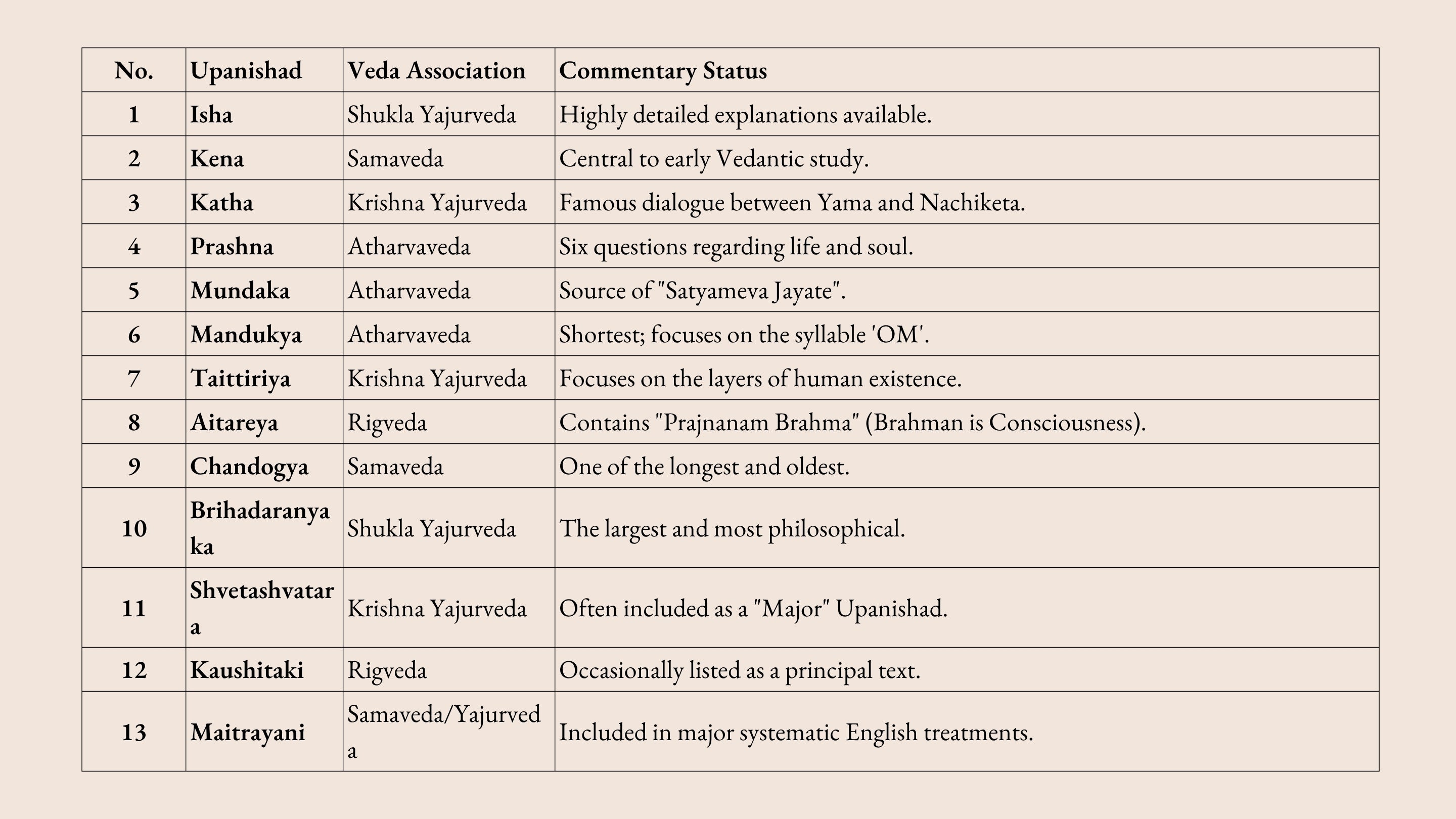
2. The 13 Principal Upanishads
The following are considered the "Major" or "Mukhya" Upanishads, for which the most detailed explanations exist:
In our next article (series), I will try to go by each one of the Upanishads in more detail.